


Friday afternoon. Your 12-year-old comes home from school on a mission: GTA VI just came out, it's Black Friday and, according to them, "everyone has it." They bring it up three times before dinner, with arguments that get more elaborate every time. Nobody in class talks about anything else. Their friend has already played it. You don't get it because "it's just a game."
You have two shortcuts at hand: a flat "no way" with no explanation, or an "okay, fine" to end the argument. Neither usually goes well. The first turns the game into forbidden fruit and takes you out of the conversation. The second brings something into your home that you may not have looked at. There's a middle path, and it starts with knowing exactly what's inside the box.
What's Inside the Box
Grand Theft Auto VI went on sale on November 19, 2026, for PlayStation 5 and Xbox Series X|S. Its official PEGI listing rates it PEGI 18, the highest level, with four content descriptors: extreme violence, sex, drugs and in-game purchases.
That number isn't arbitrary. According to PEGI's own guide, a game gets an 18 when the violence is gross, when it involves killing without apparent motive or violence against defenceless characters, and when it shows explicit sexual activity or glamorises drug use. In other words, it's not about the game being hard or "grown-up" because of its complexity. It's about what it shows and how it shows it.
Three useful caveats before you decide:
PEGI is a recommendation, not a law. The system is run by the European games industry itself and, as PEGI explains, its labels "provide guidance to consumers." In Spain, where we're based, no law stops a minor from playing a PEGI 18 game: the decision is yours.
For now, there's no online mode. The game launched without multiplayer, and Rockstar hasn't announced a date for an online version. For the time being, the risk of talking to strangers doesn't come from GTA VI but from GTA Online, the online mode of the previous game, which is still running. When the online version arrives, it'll be time to review the chat settings again.
In-game purchases are there from day one. You can play the game without paying anything more, but the door is open, and it's worth closing it before someone walks through it with your card.
If you want to get a feel for it without buying it, look up a video of the first few hours of gameplay and watch it on your own. Ten minutes are worth more than any review.
"Everyone" Is One in Four
Your kid's star argument is part truth, part exaggeration. The largest study we have in Spain, Infancia, adolescencia y bienestar digital (Childhood, Adolescence and Digital Well-being), carried out by UNICEF Spain, the University of Santiago de Compostela, the Spanish Council of Computer Engineering and Red.es with more than 75,000 students aged 10 to 20, gives these figures:
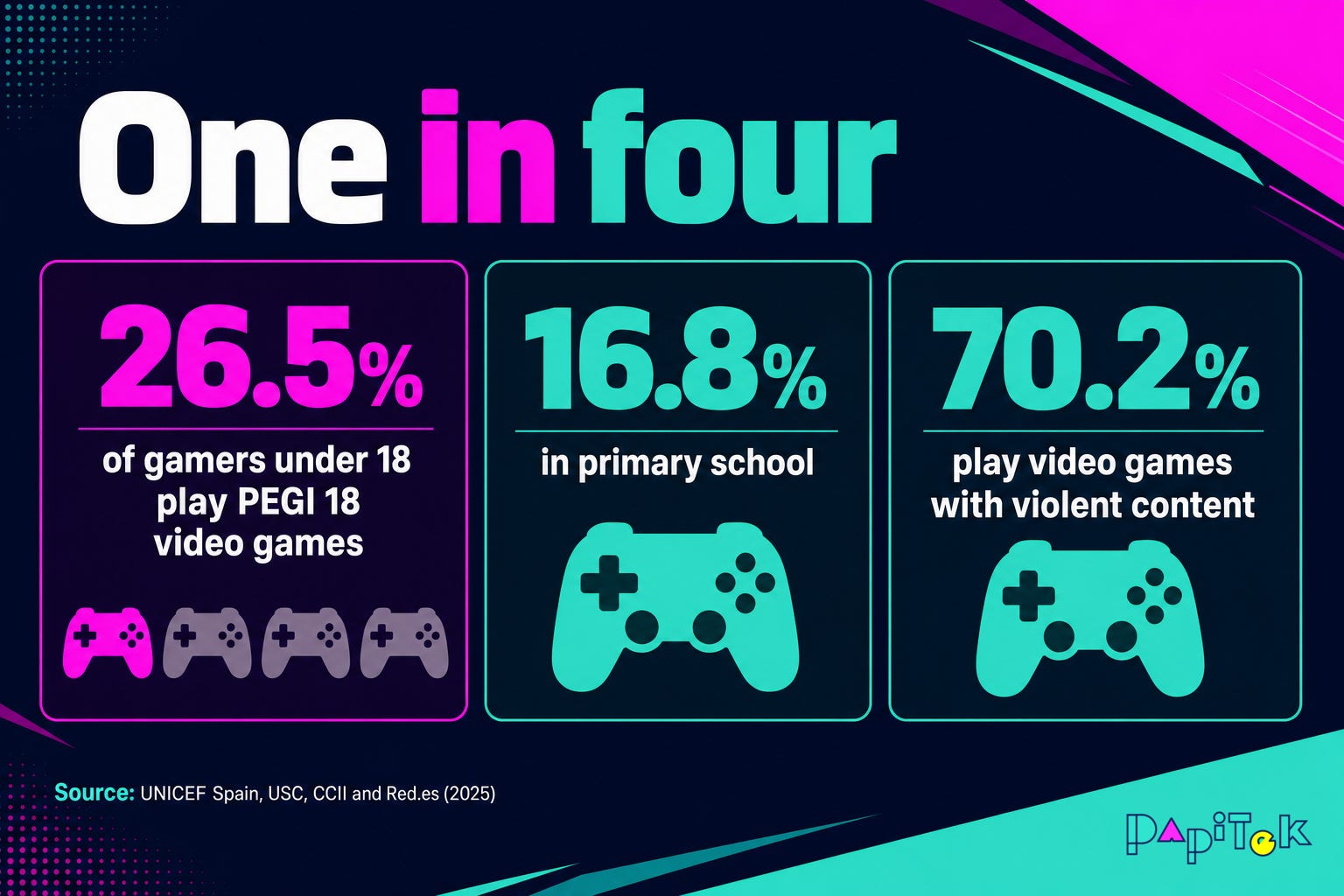
26.5% of gamers under 18 play PEGI 18 video games.
In primary school, the figure drops to 16.8%.
70.2% of gamers play video games with violent content.
So no, "everyone" doesn't have it: three out of four kids who play don't play adult titles. But it's not unusual either, and your kid very likely knows someone who does.
The same report notes that playing PEGI 18 games is associated with more cases of kids who bully others, both at school and online. Read that carefully: it's a cross-sectional study, and the authors themselves warn that it shows associations, not causes. We don't know whether the game pushes kids toward bullying or whether the kids with more problems getting along with others are also the ones who get to these games earlier. What it does say is that it's worth paying attention.
Will It Make Them Violent? What the Science (Really) Says
It's the question we've been asking since the nineties, and the answer has more nuance than a headline.
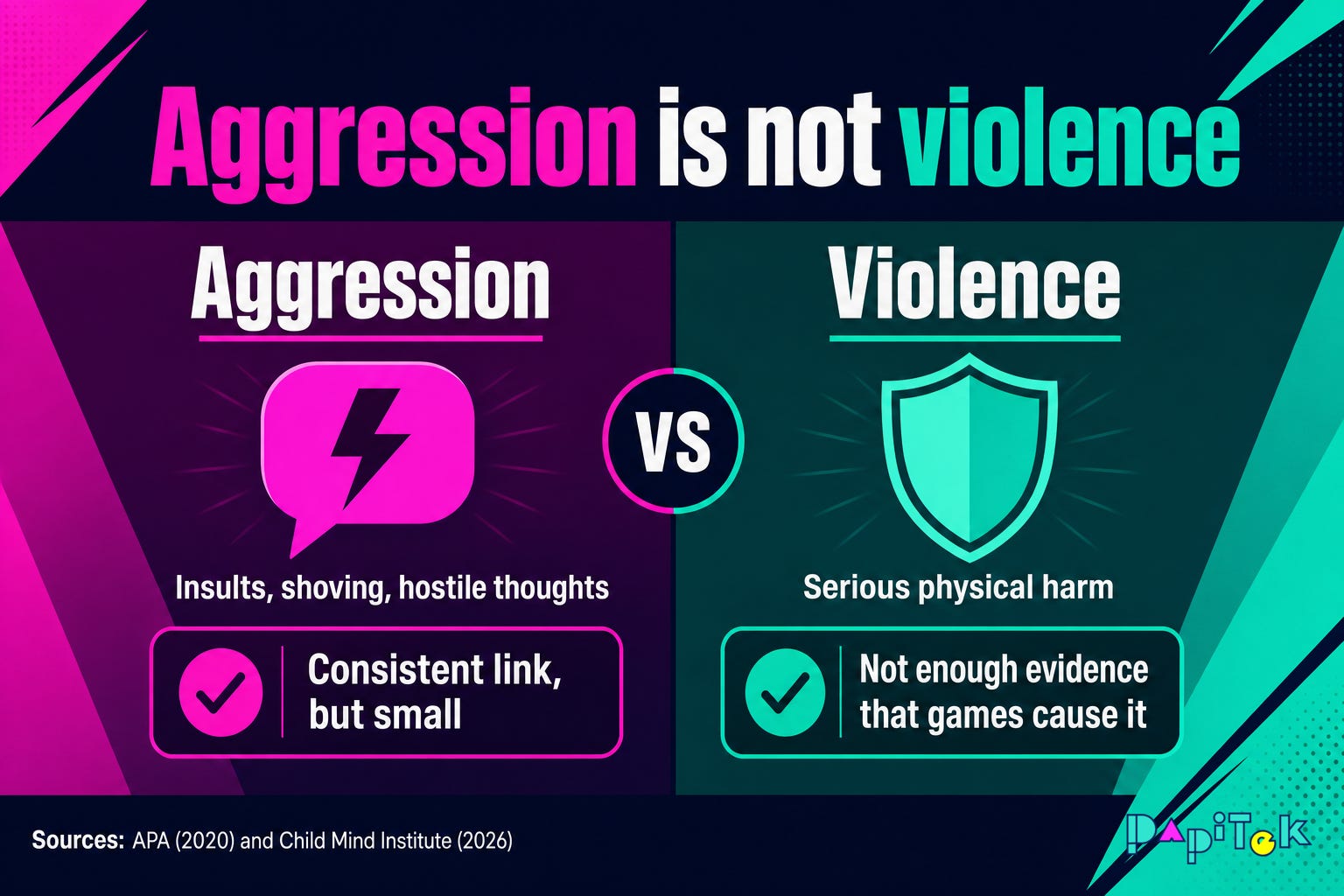
The American Psychological Association separates two things we tend to mix up. Aggression includes insults, shoving or hostile thoughts. Violence is its extreme form: causing serious physical harm. All violence is aggression, but not all aggression is violence. On the first, the link with violent video games is well studied and consistent, though small. On the second, the APA acknowledges there isn't enough research to say these games cause serious violence.
The Child Mind Institute sums it up in one line: research doesn't support a link with violent acts, but there is some evidence of more aggressive thoughts and a somewhat higher likelihood of aggressive behavior, especially in kids who are already impulsive or who play for many hours. And it adds something important: that effect is small compared with the weight of their relationship with their parents, having experienced violence at home, or the supervision they get.
Put simply: GTA VI isn't going to turn your kid into a criminal. But that's not the real question. A PEGI 18 game isn't designed for a 12-year-old because it shows them explicit sex, drugs and a way of looking at people — as targets, as obstacles, as loot — that they don't yet have the tools to put into context. The problem isn't violence in the abstract, but at what age and with whom they process it.
Three Possible Answers (and None of Them Is "Because I Said So")
There's no single right answer for every family, but some answers are better than others. Here are three, from most to least restrictive:
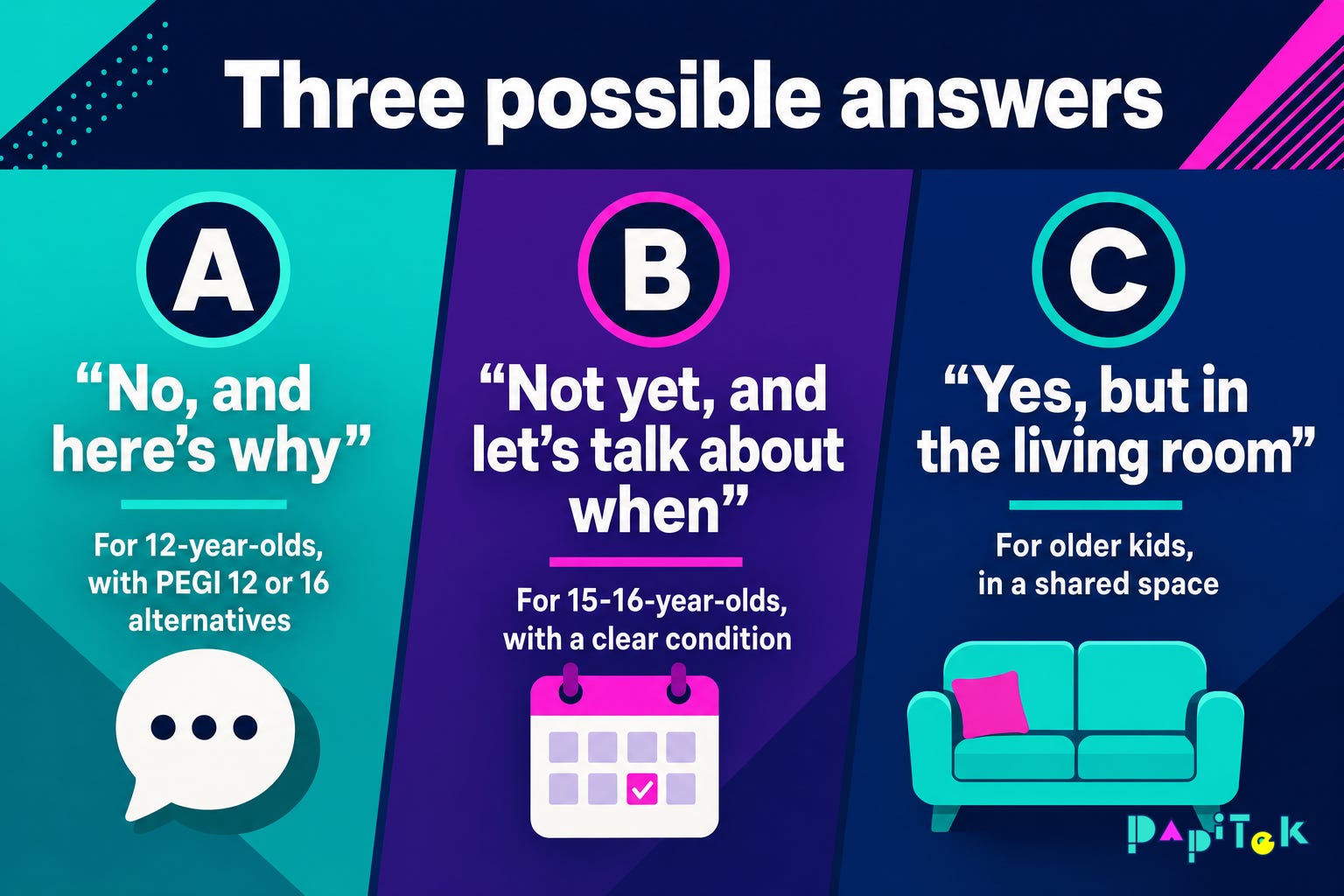
A. "No, and here's why." For a 12-year-old, this is the answer that fits the rating. The key is in the second half of the sentence: explain what the 18 means and why it isn't just you being difficult. And offer something in return: search together on the PEGI website for action or open-world games rated PEGI 12 or 16 that do suit them. A "no" weighs less when it comes with a "but this, yes."
B. "Not yet, and let's talk about when." Useful with 15- or 16-year-olds who already play PEGI 16 titles. Set a clear, checkable condition: an age, a moment or a conversation still to be had. That way the game stops being an eternal taboo and becomes one more step.
C. "Yes, but in the living room." This is the middle path the Child Mind Institute suggests, meant for older, more mature kids. The game is played in a shared space, never in the bedroom. Your kid explains what they're doing and why. You watch how it affects them: whether they sleep worse, get more irritable or skip homework. As soon as the game starts eating into sleep or schoolwork, it's time to set limits.
An honest warning: even if you say no, they'll probably see it at a friend's house or in YouTube videos. That doesn't make your decision pointless, but it does make the conversation more important. If they know why it's a no at home, they'll have more tools to process what they see elsewhere.
The Control Panel: What You Can Set Up Today
Whatever you decide, the console has tools to make your decision stick without having to watch every minute. Both platforms let you manage it from your phone.
On PlayStation 5, from Settings > Family and Parental Controls or with the PlayStation Family app:
Age level for games and apps: limits what they can open based on their age. If they want a blocked game, they can send you an exception request, and you decide.
Monthly spending limit: set to zero by default. If you raise it, make it an agreed amount.
Playtime settings: daily duration and time slots. They can ask you for more time from the console, and you accept or decline.
Communication and user-generated content: restricts voice and text chat with other players.
All the steps are in PlayStation's official guide.
On Xbox, with the Xbox Family Settings app:
Content filters: limit games by age.
Screen time: schedules for each day of the week, with the option to pause play instantly.
Ask to buy: every purchase needs your approval.
Friends and online multiplayer: decide who they can play and talk with.
A practical tip: set it up with your kid there, not behind their back. Explaining which controls you're putting in place and why turns a surveillance tool into an agreement, and an agreement gets respected a lot more.
Beyond the Box
GTA VI will pass. In a few months there'll be another game that "everyone has," and then another. What stays from this conversation isn't whether your kid played a particular game at 12, but what they learned about how these decisions get made at home: looking at what's inside, listening to their arguments and explaining yours.
In the end, age ratings aren't a wall that keeps them apart from their friends, but a map to walk together until they can decide on their own.
What about your home? Have they asked yet, and what did you say?
Sources
PEGI, Grand Theft Auto VI listing: https://pegi.info/search-pegi?id=112953
PEGI, what the labels mean: https://pegi.info/what-do-the-labels-mean
Educación 3.0, "GTA VI: qué deben saber las familias y los docentes" (Nov 20, 2026): https://www.educaciontrespuntocero.com/familias/gta-vi-familias-docentes-pegi-18/
Push Square, "GTA 6: Does It Have Online Multiplayer?" (Nov 2026): https://www.pushsquare.com/guides/gta-6-does-it-have-online-multiplayer
UNICEF Spain, USC, CCII and Red.es, "Infancia, adolescencia y bienestar digital" (2025): https://doi.org/10.30923/IABD202510
American Psychological Association, Resolution on Violent Video Games (2020): https://www.apa.org/about/policy/resolution-violent-video-games.pdf
Child Mind Institute, "Can Video Games Make Kids Violent?" (Nov 12, 2026): https://childmind.org/blog/can-video-games-make-kids-violent/
PlayStation, PS5 parental controls and spending limits: https://www.playstation.com/en-us/support/account/ps5-parental-controls-spending-limits/
Xbox Family Settings: https://www.xbox.com/en-US/apps/family-settings-app