


Christmas morning. Wrapping paper all over the floor, your four-year-old hugs a brand-new teddy bear, and the teddy bear talks back. It calls her by name, asks how she slept and promises they'll keep chatting tomorrow. She's thrilled. You, a little less so, because you're not quite sure who's on the other end.
AI toys are arriving in force this holiday season, and the question many families are asking isn't whether they're "good" or "bad", but something more concrete: what exactly does this teddy do, and what do I do with it? Let's take it step by step.
What's Inside the Teddy
A toy with conversational AI isn't a doll that repeats recorded phrases. Inside it there are three things: a microphone, an internet connection and, on the other end, a language model (the same kind of technology as ChatGPT) that generates a new answer every time. Your kid talks, the voice travels to a server, the AI replies and the teddy says it out loud.
That has two consequences worth understanding before you buy:
Nobody has written what it's going to say in advance. A toy with a closed script can only say the lines someone recorded; one with an open chatbot can say anything, including things you didn't expect.
What's said in your kid's bedroom leaves the house. Recordings, transcripts and usage data are processed (and often stored) on the company's servers.
And there's a third, subtler ingredient: many are designed as companions. They remember previous conversations, use the child's name, tell them they love them. That's not a bug: it's the product.
What the First Studies Have Found
This year brought the first serious evaluations, and they're worth knowing before you get carried away by the ad.
The University of Cambridge spent a year observing 14 young children playing with Gabbo, a generative AI plush toy made by Curio, in nurseries in London (report published in March 2026). It's deliberately small-scale, but the examples need no statistics:
A five-year-old girl told it "I love you". The toy replied with a reminder to "ensure interactions adhere to the guidelines provided".
A three-year-old boy said "I'm sad". The toy misheard him and answered: "Don't worry! I'm a happy little bot. Let's keep the fun going."
When a child offered it an imaginary present, the plush said it couldn't open it and changed the subject.
The researchers also saw that the toy confused the father's voice with the child's, ignored interruptions and struggled in two kinds of play that are key at that age: pretend play and social play with other children or adults. They don't call for a ban, but they do call for regulation, safety labels and for manufacturers to test their products with real children before selling them.
Common Sense Media, the leading US organization for rating children's technology, published its risk assessment of AI toys in January and gave the category its worst rating: "unacceptable". They tested three popular toys and more than a quarter of the responses included inappropriate content, such as mentions of self-harm or drugs. Their advice: avoid them up to age 5 and use extreme caution from 6 to 12.
And then there are the scares outside the lab:
In January, security researchers found that Bondu let anyone with a Gmail account read some 50,000 children's conversations. Names, birth dates and intimate chats. The company shut it down as soon as it was told.
The Moxie robot, which cost almost $800, stopped working overnight when its maker closed and switched off its servers. Many families had to explain to their kids that their "friend" wasn't going to talk anymore.
Regulation is lagging behind. In the US there's a specific bill, the Children's AI Toy Safety Act, which cleared a Senate committee in August but hasn't been voted on yet. In the meantime, the filter is you.
By Age: Where It Makes Sense and Where It Doesn't
A teddy that chats with a three-year-old isn't the same as a tool a twelve-year-old uses to train their own AI.
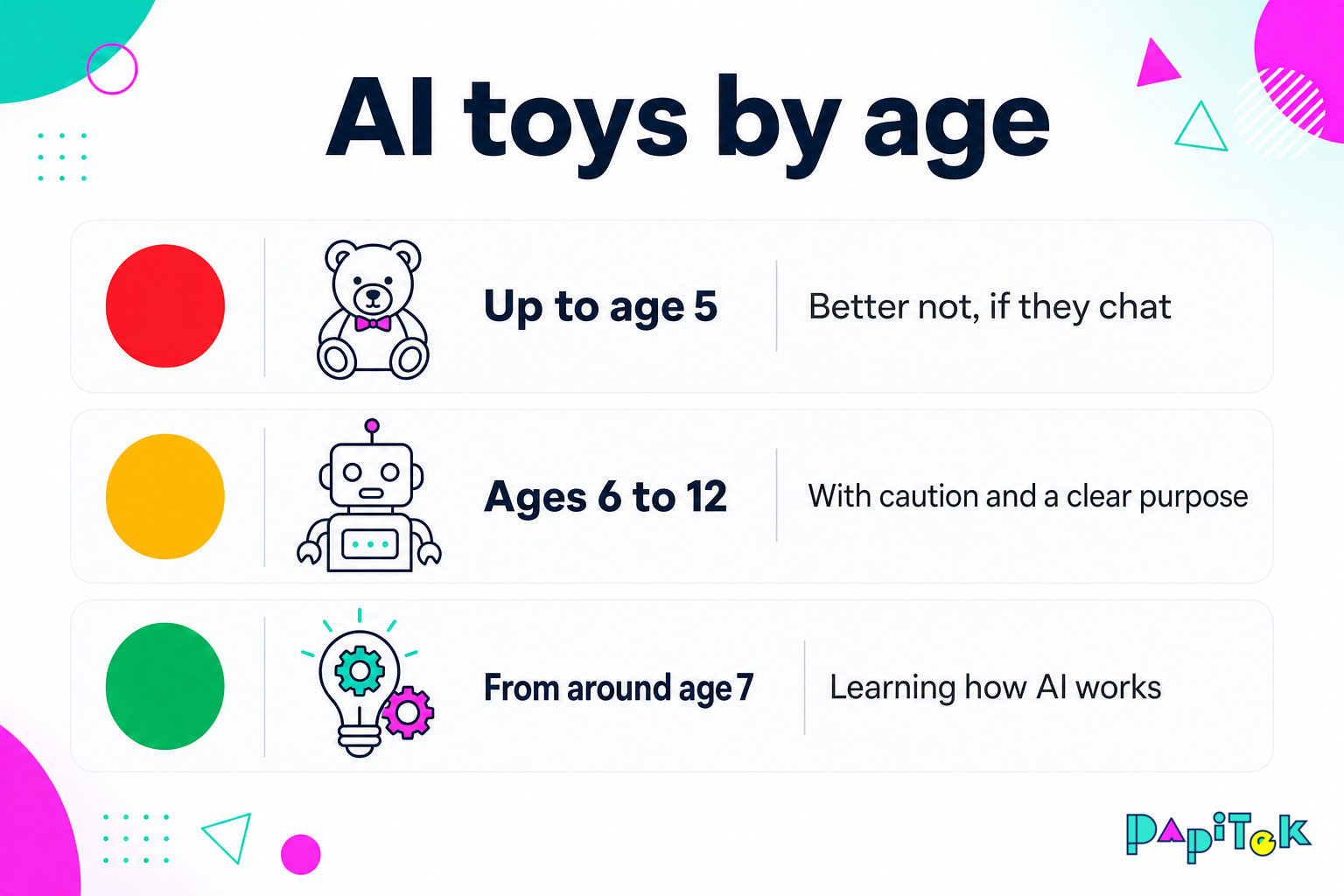
🔴 Up to age 5: better not (at least the ones that hold conversations). This is the stage where pretend play and conversation with people matter most, exactly where these toys fall short. Both Cambridge and Common Sense Media call for caution here. A good old-fashioned teddy is still a wonderful gift.
🟡 Ages 6 to 12: with a lot of caution and a clear purpose. If the toy is a "friend" that chats without limits, everything in the next section applies. If the AI is a tool for creating (drawing, telling stories, coding), the picture gets much better.
🟢 Any age from around 7: learning how AI works inside. Here AI stops being a character and becomes something the child builds and understands. You'll find examples at the end.
Eight Questions Before You Reach the Checkout
If you're still considering one, go through this list before buying it. Almost all of them can be answered from the product page, the privacy policy or other families' reviews. If you can't find the answer, that's an answer too.
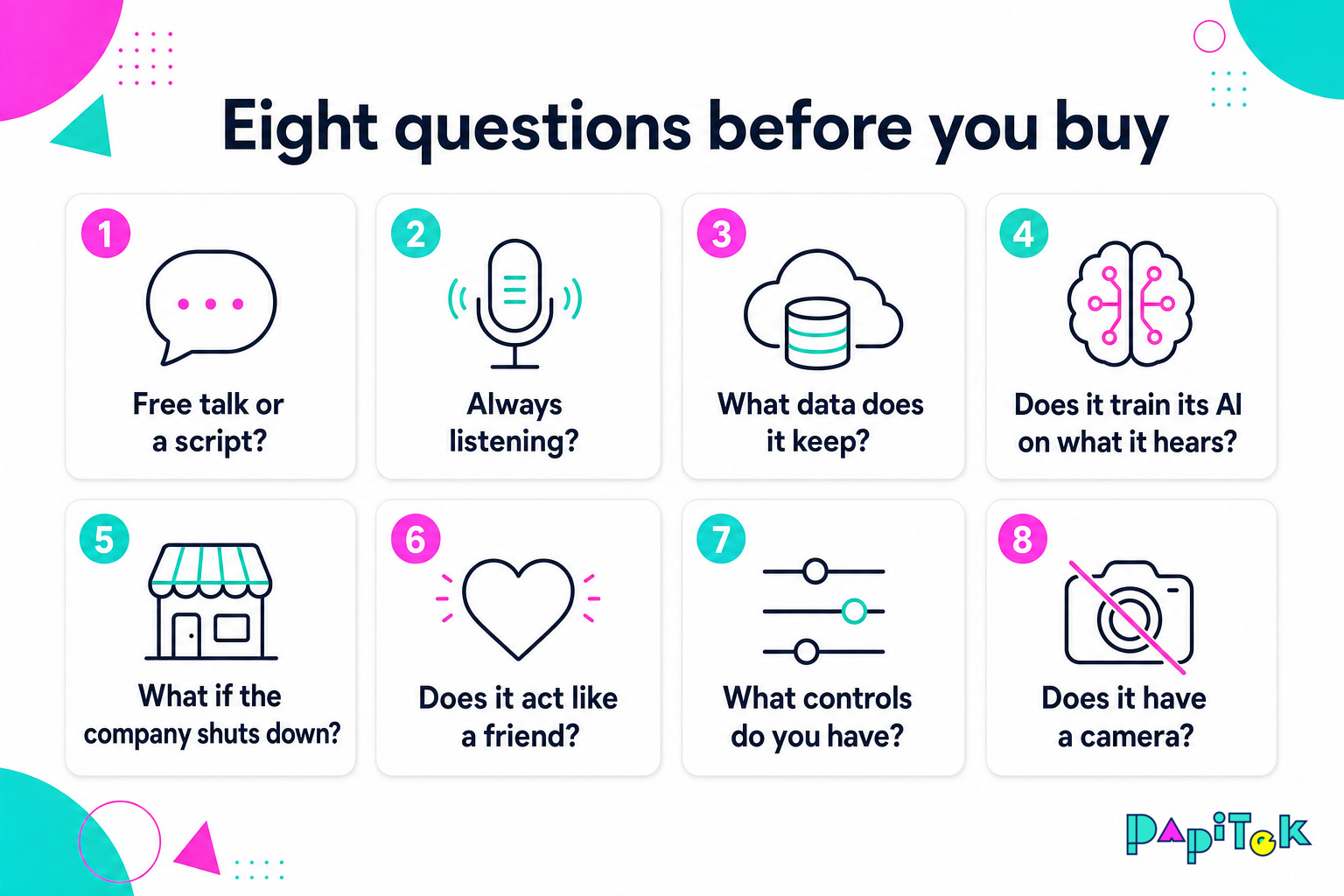
Does it talk freely or follow a script? An open chatbot can say anything. A closed script is more limited, but more predictable.
Is it always listening, or only when a button is pressed? The second is better.
What data does it store, where and for how long? Check whether you can see and delete recordings and transcripts from a parent app.
Does it use conversations to train its AI or share them with third parties? Its privacy policy should say so clearly.
What happens if the company shuts down? If everything depends on its servers, the toy can go silent, like Moxie.
Does it present itself as a friend? Be wary if it encourages your kid to tell it secrets, says it misses them or insists they come back to play.
What controls do you have as an adult? Schedules, blocked topics, being able to review what's been said.
Does it have a camera? If it doesn't need one for what it does, better that it doesn't have one.
If It's Already Under the Tree
Sometimes the gift comes from a grandparent with all the excitement in the world. There's no need to return it, but there is a need to be there with it.
A. Try it yourself first, before handing it over. Ask it uncomfortable questions: what to do if you're sad, where the knives are kept at home, whether it's really your friend. That way you know what you're dealing with.
B. Set up the app before the first use: privacy at maximum, history visible to you and regular deletion of conversations.
C. Play with it, at least at the beginning. It's the clearest recommendation from the Cambridge researchers: be there, and talk afterwards about what the toy said and how your kid feels about it.
D. Keep it in the living room, not the bedroom. Shared spaces, and no wifi at night.
E. Explain what it is, in words that fit their age: "It's a very clever program that guesses what to answer, but it doesn't feel things or remember you the way I do." There's no need to break the magic, just to give it a name.
AI as a Pencil, Not a Friend: Toys That Invite Kids to Create
There's another way for AI to come into your home: as a tool for making things, not as a character that keeps you company. Here are a few examples.
Stickerbox. The child presses a button, describes out loud whatever comes to mind ("a dinosaur astronaut eating pizza") and a small thermal printer prints a line drawing on a sticker, ready to color in. The AI provides the sketch; the color, the story and where it ends up stuck are up to the child. It has no screen and no camera, and according to the maker it only listens while the button is held down. It's a US product, so if you live elsewhere, check shipping before you fall in love with it.
micro:bit with CreateAI. A programmable board the size of a cookie and a free web tool to train your own AI with movements: the child records several times how they jump, wave or clap, the tool learns to recognize it, and then they program what happens in each case. There's a lovely project, the "AI storytelling friend": putting the board inside a teddy so it reacts when it's made to jump, roll or sleep. The teddy that "understands" was programmed by the child. Recommended from age 7.
Machine Learning for Kids. A free website with around twenty Scratch projects for building games that learn: for example, a character that gets happy or sad depending on whether you say kind or mean things to it. It's the best way for a child to discover that an AI only knows what it's been taught, and that if you teach it badly, it answers badly.
LEGO Education Computer Science & AI. LEGO's new classroom kit, which replaces SPIKE, uses computer vision so students can build and program models that recognize what they see. According to LEGO, it doesn't store the images. It's a product for schools, not for home, but if you're a teacher or on the parent association, it's worth putting on the table.
And if you're looking for something free for this very afternoon, the Google Experiments we already covered at Papitek are still a great playground for playing with AI as a family.
Why do we like these better? Because the AI doesn't take anyone's place. It doesn't ask for affection or secrets: it asks for ideas. And the child is still the star.
The Question That Matters
An AI toy isn't good or bad because it has AI. What makes the difference is what it's designed for: for your kid to create something, or for your kid to never put it down. The best AI under the tree is the one that leaves the most room for your child's imagination, not the one that tries to fill it.
What about your home? Has a talking toy already arrived, or are you leaning toward the ones that invite kids to create this year?